
Legal Literacy - This article discusses strategies for combating narcotics crimes in Indonesia through supply and demand reduction approaches. Narcotics smuggling, categorized as an extraordinary crime, has shown a significant increase in recent years and is considered a threat to national security. The discussion includes statistical analysis of smuggling, the negative effects of narcotics, and the role of Law Number 35 of 2009 concerning Narcotics. Furthermore, the article explains the government's policies in breaking the chain of narcotics users (demand reduction) and narcotics syndicate networks (supply reduction), as well as the juridical handling of this transnational crime, including relevant criminal sanctions.
The Problem of Narcotics Crimes in Indonesia
The circulation of narcotics in Indonesia is increasingly rampant from year to year. This action does not only occur domestically, but also across national borders. Based on statistical data on narcotics handling from the Center for Data and Information Research (Puslitdatin) of the National Narcotics Board (BNN), there were 461 smuggling cases in 2019, 568 cases in 2020, 449 cases in 2021, and 768 cases in 2022 until March 2023.


Basically, narcotics are often misused, causing negative effects for users. Therefore, everything related to narcotics, such as misuse, distribution, and drug smuggling, is often associated with crime because it is often considered to have negative effects and causes users to commit crimes.
In general, the problem of narcotics crimes is a problem for the Indonesian nation and the nations of the world, especially in cases of cross-border narcotics smuggling. Narcotics smuggling can be categorized as an Extraordinary Crime. According to the BNN, air and sea routes are frequently used to smuggle narcotics into Indonesia. Air routes generally go through Bangkok to cities in Indonesia, such as Medan, Jakarta, and Bali.
The existence of narcotics smuggling is due to the process of supply and demand for narcotics in Indonesia and internationally. In addition, regulations regarding the rehabilitation of perpetrators of criminal acts are considered not strict enough. This is a challenge in combating narcotics smuggling. For this reason, how does the government overcome these problems in order to remain safe from the threat of narcotics? Then, how is the handling of narcotics smuggling viewed from a juridical aspect? This will be discussed in this paper.
As previously explained, narcotics can threaten the Indonesian nation due to the negative effects that arise from their misuse. In Indonesia, legal regulations regarding narcotics are regulated in Law Number 35 of 2009 concerning Narcotics (Narcotics Law). On an international scale, there are legal regulations regarding narcotics circulation formulated in The United Nation’s Single Convention on Narcotic Drugs 1961.
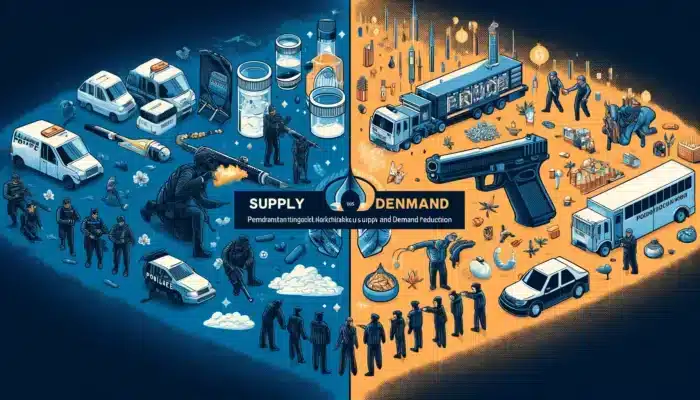
In addition, the policies issued by the government to combat narcotics smuggling cases pay attention to the supply and demand side, also known as supply and demand. This makes the government strive to reduce supply and demand as a step in combating narcotics. This policy is a preventive effort by the government by breaking the chain of narcotics users (demand reduction) and law enforcement efforts (supply reduction) by breaking the narcotics syndicate network.

Supply Reduction
In more detail, supply reduction is a handling effort in combating narcotics that aims to reduce the supply and circulation of narcotics in society. In addition, the supply reduction approach is used to prevent narcotics trafficking and break the distribution chain, including in the case of narcotics smuggling. The scope of supply reduction, includes production reduction, distribution termination, and asset confiscation. At the production reduction stage, efforts are made by eradicating sources of narcotics, such as strengthening regulations on narcotics crop cultivation land, eradicating illegal drug trade organizations, strict drug regulations, and monitoring and prohibiting narcotics-related precursors.
Furthermore, there is a distribution termination stage which can be carried out by reducing the availability of illegal drugs. According to the Office of National Drug Control Policy it is done in several ways, including dismantling narcotics trafficking and its distribution chain, cooperating with international institutions in narcotics control, eradicating narcotics trafficking via the internet, dismantling narcotics production infrastructure, monitoring goods shipments at expeditions, and increasing the capacity of law enforcement officials. In addition, there is an asset confiscation stage which is carried out by confiscating narcotics goods.
Demand Reduction
Meanwhile, demand reduction is a narcotics control effort that aims to reduce the demand for narcotics. This is generally done through preventive measures, such as holding drug abuse prevention programs in the community and programs to improve values, attitudes, skills, and behaviour thereby encouraging resistance to drug abuse. The scope of demand reduction, includes strengthening personal resilience (immunity), strengthening communal resilience (community), restoring drug-prone areas, and strengthening rehabilitation programs.
In addition, as a crime, there needs to be an action to eradicate narcotics smuggling and trafficking which can threaten the security of the nation. To complement and support the supply and demand reduction narcotics policies, there is also a policy to combat crimes of drug smuggling. This policy can be carried out using penal or criminal sanctions.
The existence of the Narcotics Law is a criminal law policy in terms of eradicating narcotics crimes. In general, smugglers or dealers can be oriented as sellers, suppliers or buyers to be distributed, stored, controlled, and which involve narcotics smuggling activities through exports and imports.
In the Narcotics Law, criminal provisions are regulated in Chapter XV Articles 111 to 148. There are several categories of illegal acts that are prohibited in the Narcotics Law which are accompanied by the threat of criminal sanctions, especially those related to narcotics smuggling. These categories are in Category II, in the form of acts of producing, importing, exporting, or distributing narcotics and narcotics precursors which are regulated in Article 113, Article 118, Article 123, and Article 129 letter (b) of the Narcotics Law. Then, there is Category IV in the form of acts of carrying, sending, transporting, or transiting narcotics which are regulated in Article 115, Article 120, Article 125, and Article 129 letter (d) of the Narcotics Law.
Furthermore, regarding the types of criminal sanctions regulated in the Narcotics Law in the case of narcotics smuggling, they are regulated in several articles, including Article 132 and Article 133 of the Narcotics Law. Article 132 regulates attempts and criminal conspiracy to commit narcotics crimes and Article 133 of the Narcotics Law for those who order or give narcotics illegally, are subject to the death penalty or life imprisonment, or imprisonment for a minimum of 5 (five) years and a maximum of 20 (twenty) years and a fine of at least IDR 2,000,000,000.00 and a maximum of IDR 20,000,000,000.00.
Based on this, eradicating narcotics smuggling is a problem for the Indonesian nation and nations throughout the world. The existence of narcotics smuggling is included in transnational crime because it is rife to the point of crossing national borders. The government's policy to overcome this problem is to break the chain of users (demand reduction) and break the network of narcotics trafficking syndicates (supply reduction). In addition, juridically, handling narcotics smuggling is overcome by Law No. 35 of 2009 concerning Narcotics. The Narcotics Law also regulates sanctions and criminal threats for those who commit narcotics crimes, one of which is narcotics smuggling which is regulated in Article 132 and Article 133 of the Narcotics Law.
In addition to the policies that have been issued, there are still loopholes in committing narcotics crimes, especially narcotics smuggling. So what must be considered and improved is that there needs to be government action to be more vigilant about buying and selling activities both at the country's borders and within the country. In addition, there needs to be firmer action from the government to eradicate narcotics crimes in Indonesia.
From a regulatory perspective, what the government is doing based on legislation still has shortcomings, which need to be detailed regarding the rehabilitation of perpetrators of criminal acts so that the perpetrators do not repeat these actions and increase public awareness of narcotics crimes, especially regarding narcotics smuggling. Rehabilitation also needs to be given not only to perpetrators as narcotics users, but also to perpetrators who distribute narcotics even if they do not consume them.
References
- Dimas Putra Catur Prasetyo, et al. 2023. “Nontraditional Syindicated Narcotics Smuggling in Southeast Asia and Oceania.” RechtIdee 18 (2): 2.
- Gukguk, Roni Gunawan Raja. 2019. “Narcotics Crimes as Transnational Organized Crime.” Jurnal Pembangunan Hukum Indonesia 1 (3): 349.
- Muhamad, Simela Victor. 2015. “Transnational Crime of Drug Smuggling from Malaysia to Indonesia: Cases in the Riau Islands and West Kalimantan Provinces.” Politica 6 (1): 48-49.
- Nasional, National Narcotics Board. 2021. P4GN Index of Prevention and Eradication of Drug Abuse and Illicit Trafficking 2020. Jakarta: National Narcotics Board.
- Sudanto, Anton. 2017. “The Application of Narcotics Criminal Law in Indonesia.” ADIL: Jurnal Hukum 7 (1): 150.
- Law Number 35 of 2009 concerning Narcotics






















Comments
0Share your perspective politely, stay relevant, and focus on the article. Comments appear after moderation.
Join the discussion
Write a clear, polite response that stays on topic.
No comments yet. Be the first to discuss.
Comments will appear after moderation.