Legal Literacy - Choosing a leader in an era democracy full of challenges. This article discusses criticisms of democracy and offers a guide to choosing a leader based on the values of Liberté, Égalité, and Fraternité.

Critique of Democracy

By definition, democracy is often defined as government of the people, by the people, for the people. Democracy itself first set foot in ancient Greece, which received sharp criticism from a famous philosopher of that time, namely Socrates.

Socrates stated that democracy is like a ship. A person who does not understand navigation could become the leader of everyone on the ship, and this is certainly very dangerous. Socrates interpreted democracy as a group of people who do not understand the direction of navigation but ask to sail in a certain direction; if the captain also does not understand navigation well, then the ship has a very high chance of getting lost.

Besides Socrates, Plato also offered an alternative critique of democracy. According to him, democracy has the potential to produce officials who are oriented towards oligarchy, namely the election of a group of people due to their wealth to obtain strategic positions in the government which are used to carry out all forms of their interests.

Jacques Ranciere a philosopher from the birthplace of modern democracy, France, shares a similar opinion with Plato that the problem of democracy itself lies in the vulnerability of the government being held by an oligarchy.

Liberté, Égalité, Fraternité

Centuries after the glory of Ancient Greece ended, a major event occurred that is very influential to this day. A revolutionary people's movement called the French Revolution. This movement became the background for the birth of modern democracy with all kinds of assimilation adjusting to the times with its slogan that is very legendary, namely Liberte, Egalite, Fraternite and has been jointly agreed as the three basic values of democracy universally.

The French Revolution itself was marked by public dissatisfaction with the performance of the government of King Louis XVI, which was considered incompetent and the occurrence of a financial crisis. This event began with the holding of a meeting of people's representatives from various groups, namely the clergy, nobles, and common people. King Louis XVI became a victim of this historic event by being executed in front of his people.

Advertisement
Read without ads.
Join Membership
  • Liberte

When viewed based on language, Liberte in French itself means “freedom” which later in English is also called liberty with the same meaning, namely freedom. Based on this linguistic point of view, it indicates that the people felt very shackled by policies and the monarchy system that seized people's freedom.

  • Egalite

In French, egalite means equality which is intended so that every group of society has the same opportunity to fulfill their rights without being discriminated against.

  • Fraternite

It means solidarity or what is more often called brotherhood in French. This is closely related to the natural state of humans as zoon politicon.

Guide to Choosing a Leader

As a a country that recognizes the sovereignty of the people is the highest, so it is fitting that general elections (elections) become a grand celebration in the process of determining the country's leaders for the next five years to achieve democratic ideals. The three basic values of democracy that emerged from the French Revolution can essentially be used as a reference in the election process.

Determining the choice of a Presidential Candidate is indeed the prerogative of every individual. However, there are three basic values of democracy that can be used as a new perspective to determine political choices:

  • Liberty

Democracy always dreams of freedom in various aspects, which initiated the birth of Human Rights (Human Rights). According to the philosophy of Hegel and Hobbes, the law must protect the freedom it shelters.

Advertisement
Read without ads.
Join Membership
  • Equality

Human rights that arise from the idea of freedom demand equality for every citizen in the implementation of obligations and fulfillment of rights, especially equality before the law.

  • Fraternity

The state, represented by the President as its leader, must consider every citizen as a group of solidarity that has a reciprocal relationship with one another.

Conclusion

Choosing a President and Vice President should ideally use clear and accountable arguments. These basic values of democracy can be used as a guidebook to determine where our choice will fall.

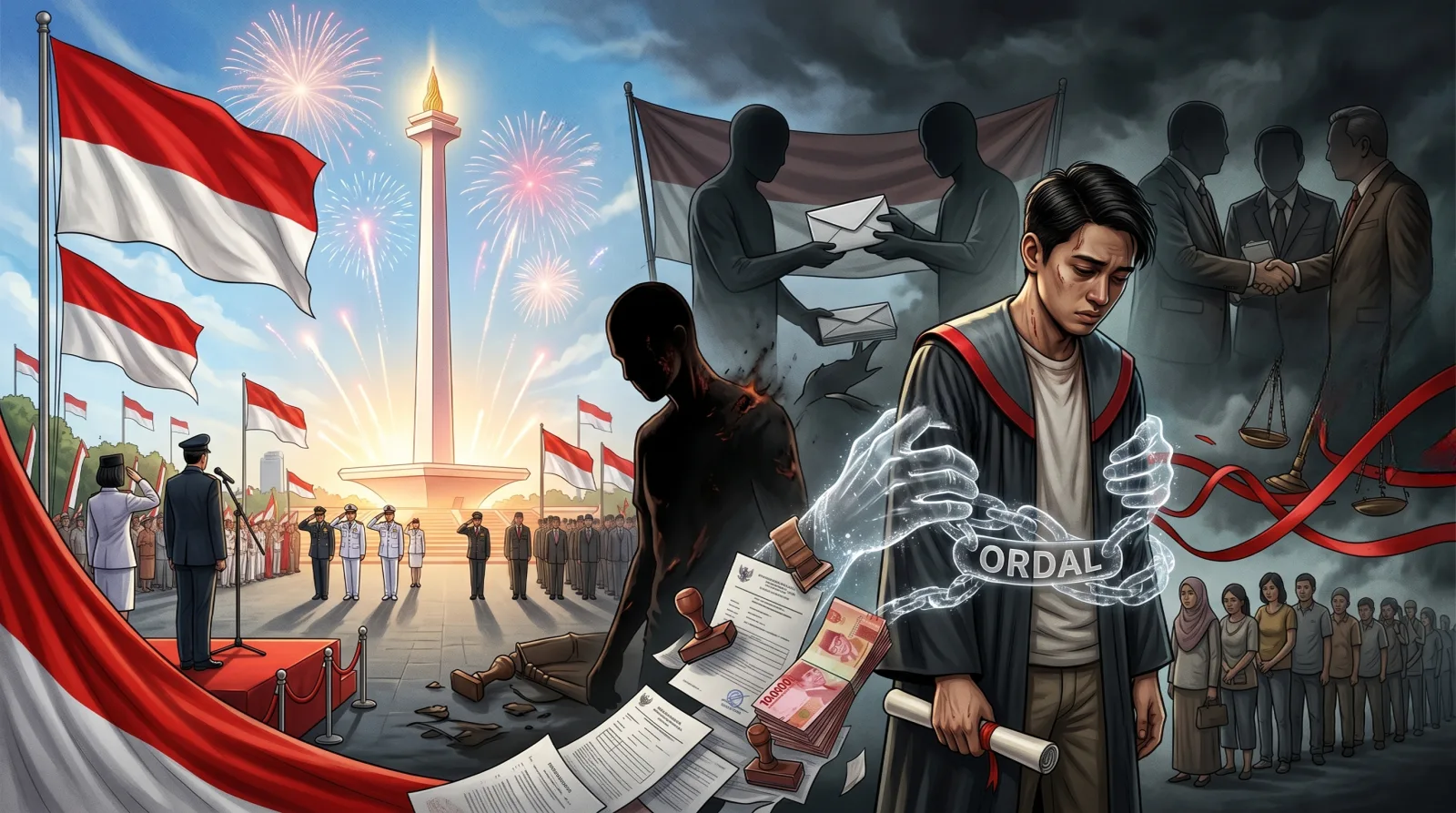
So far, Indonesia's political journey is still limited to money campaigns (whoever wants to give more money will be chosen) or what is more commonly known as 'dawn attacks'. In addition, religious campaigns are also an attractive area for politicians. Indonesia is still easily tempted by theo-democracy, where when religious leaders show their political choices, the people below them will follow, which sometimes does not align with their conscience.

Choosing a national leader should at least be based on liberte, egalite, and especially fraternite. When we choose without thorough research and thought, it is possible that our choice will have a negative impact on other Indonesian citizens, which could injure the sense of brotherhood of the nation and homeland. Choose a leader because we care about the fate of this country, because we care about 'liberte', care about 'egalite', and care about 'fraternite'.