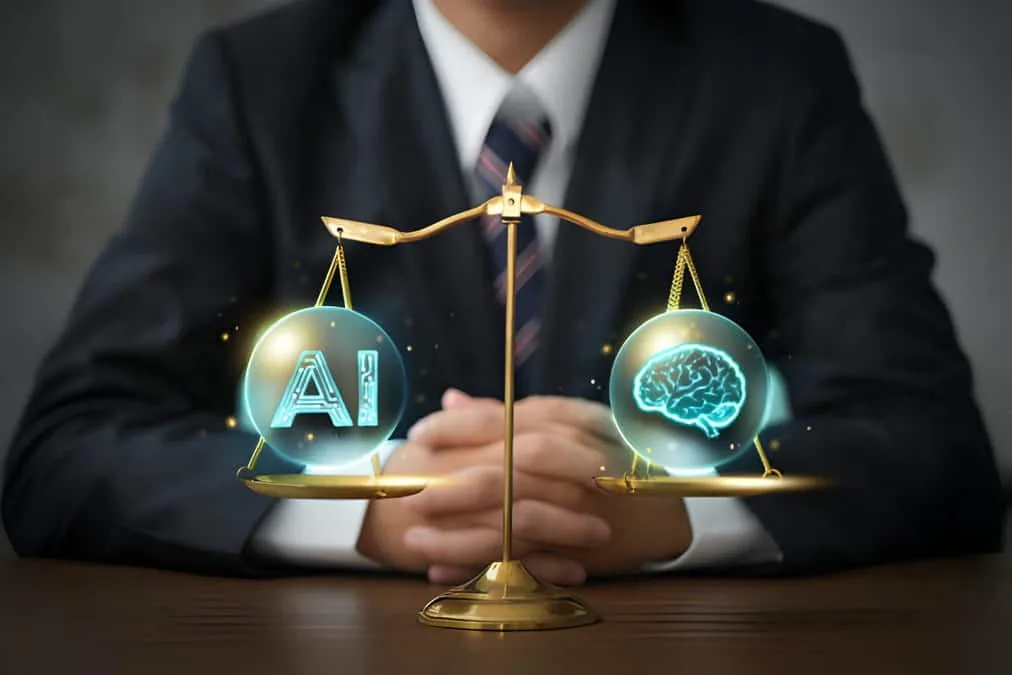
Legal Literacy - Attendance artificial intelligence (AI) or artificial intelligence has a significant influence on human life. The existence of AI not only impacts technological, business, and economic developments, but also has a disruptive effect on the legal sector.
Through this article, we will discuss artificial intelligence and its influence on the legal profession.


Understanding Artificial Intelligence (AI)
Referring to the Indonesian Dictionary (KBBI), artificial intelligence or artificial intelligence is a computer program that mimics human intelligence, such as making decisions, providing a basis for reasoning, and other human characteristics.
Meanwhile, the Circular Letter of the Minister of Communication and Informatics Number 9 of 2023 concerning the Ethics of Artificial Intelligence defines AI as a form of programming on a computer device in carrying out data processing and/or processing carefully.
Implementation artificial intelligence in Indonesia has brought major changes to efficiency and innovation in various sectors of people's lives.
Regulations on Artificial Intelligence
The use of AI as the latest technology requires governance so that it can be run safely and effectively. The application of regulations on artificial intelligence is important to reduce the risk of impacts and losses that may arise. That way, threats that may arise from technological developments artificial intelligence can be minimized.
In this case, Deputy Minister of Communication and Informatics (Wamenkominfo) Nezar Patria stated that Indonesia does not yet have specific regulations regarding artificial intelligence. However, the use of this technology can still be accommodated through existing policies such as the Law on Electronic Information and Transactions (ITE) and Government Regulations (PP) on the Implementation of Electronic Systems and Transactions (PSTE).
In addition, the Indonesian government through the Ministry of Communication and Information has issued Circular Letter of the Minister of Communication and Informatics of the Republic of Indonesia Number 9 of 2023 concerning the Ethics of Artificial Intelligence. The Circular Letter (SE) explains several things, such as what artificial intelligence is and the ethics that apply.
Referring to the SE above, artificial intelligence ethics is the foundation that regulates ethical principles and norms in the implementation of programming based on artificial intelligence which is based on the values of inclusiveness, transparency, humanity, and security in the management of available data resources.
The development of ethical guidelines for artificial intelligence aims to ensure that the technology is used with consideration of ethical principles, caution, safety, and is oriented towards positive impact.
Influence Artificial Intelligence on the Legal Profession in Indonesia
The legal profession is a profession that is inherent in and carried out by legal apparatus in the government of a country. Professions in this field play a role in providing services that handle legal problems.
Behind the complexity of artificial intelligence, the presence of this technology also opens up opportunities to accelerate the work of the legal profession. One of these advances has been implemented since 2017 in Hangzhou City, China. They use artificial intelligence in the profession of judge. However, not all problems can be handled by the AI judge.
Meanwhile, legal disputes that can be handled by AI judges are only limited to digital aspects, such as trade online, issues regarding copyright, as well as liability claims on products sold one-commerce.
Although some cases or tasks can be handled by advancements artificial intelligence, the profession of judge cannot be completely taken over by AI technology. The juridical use of artificial intelligence has been stipulated in Article 28C of the 1945 Constitution which reads:
“Every person has the right to develop themselves through the fulfillment of their basic needs, has the right to education and to obtain benefits from science and technology, arts and culture, in order to improve the quality of their life and for the welfare of humanity.”
However, artificial intelligence, when viewed from a normative perspective, still cannot replace the profession of judge. This refers to the requirements for a judge as written in Article 14 paragraph (1) of Law Number 49 of 2009 concerning the Second Amendment to Law Number 2 of 1986 concerning General Courts. Through this article, it is required that to become a Judge of the District Court, the following criteria must be met:
- Indonesian citizen
- Devout to God Almighty
- Loyal to Pancasila and the 1945 Constitution
- Not a former member of a banned organization PKI, including its mass organizations or not someone who is directly or indirectly involved in the "G30.S/PKI Counter-Revolutionary Movement" or similar banned organizations
- Civil servant
- Law graduate
- At least 25 (twenty-five) years old
- Authoritative, honest, fair, and of impeccable character.
Continued in Article 15 paragraph (1), the requirements to become a High Court Judge include:
- Requirements as referred to in Article 14 paragraph (1) letters a, b, c, d, e, f, and h
- At least 40 (forty) years old
- Have at least 5 (five) years of experience as Chairman or Deputy Chairman of a District Court or 15 (fifteen) years as a Judge of a District Court.
Not only that, the Circular Letter of the Minister of Communication and Informatics Number 9 of 2023 concerning the Ethics of Artificial Intelligence also explains the responsibility for the use of AI technology, one of which is to ensure that artificial intelligence is not organized to be the determinant of policies and/or decision-makers concerning humanity. Based on this statement, it can be concluded that the use of artificial intelligence in Indonesia cannot currently be used to replace a judge's decision. Even so, AI technology can be used to provide recommendations or input to judges before deciding a case.
AI technology also cannot replace legal professions such as advocates because to carry out this profession, the aspects in Article 3 paragraph (1) of Law Number 18 of 2003 concerning Advocates must be met. Likewise, the profession of prosecutor must meet the requirements that have been regulated in Law Number 16 of 2004 as amended by Law Number 11 of 2021 concerning the Prosecutor's Office.
Although it does not completely take over legal professions, AI technology has a major influence in helping the work of this profession. For example, artificial intelligence is able to perform data analysis, review documents, and so on.





















Comments
0Share your perspective politely, stay relevant, and focus on the article. Comments appear after moderation.
Join the discussion
Write a clear, polite response that stays on topic.
No comments yet. Be the first to discuss.
Comments will appear after moderation.