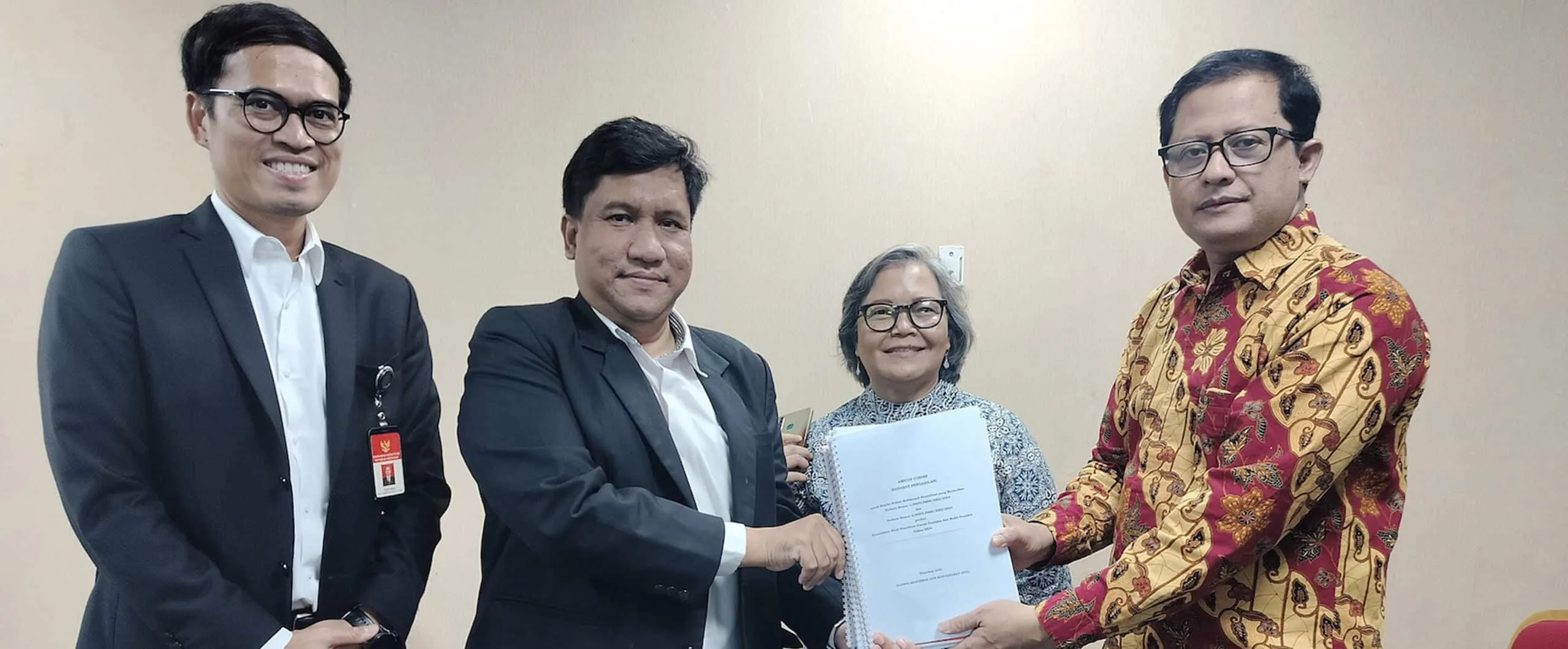
Jakarta, Legal Literacy - A total of 303 figures from the Alliance of Academics and Civil Society have submitted themselves as friends of the court (amicus curiae) to Constitutional Court in the case of the dispute over the results of the presidential and vice-presidential election. They expect the Constitutional Court to consider the disqualification of the Prabowo Subianto-Gibran Rakabuming Raka pair without hesitation.
In this effort, Professor of Legal Anthropology at the University of Indonesia, Sulistyowati Irianto, and lecturer at the State University of Jakarta, Ubedilah Badrun, have submitted the amicus curiae documents to the Constitutional Court on Thursday (28/3/2024). They represent 303 figures consisting of professors, academics, and members of civil society. The submitted document contains 17 pages and is addressed to the eight Constitutional Court justices handling the two cases of disputes over the results of the presidential and vice-presidential election.


Sulistyowati stated, "We sincerely hope that the Constitutional Court justices will not only ensure justice in the formal procedural aspect, but also in the substantial aspect. We want a holistic assessment of this case, considering the entire process, because the final result is highly dependent on the process."
Contents of the Amicus Curiae Document
In the received amicus curiae document, the figures provide three conclusions and recommendations to the eight Constitutional Court justices. First, they affirm that the General Elections Commission (KPU) misinterpreted Constitutional Court Decision Number 90/PUU-XXI/2023 which established the vice-presidential candidate number 2, Gibran Rakabuming Raka. Second, the KPU's error in interpreting the decision caused the determination of Gibran in KPU Decree No. 1632/2023 to be null and void because Gibran did not meet the requirements expanded by Constitutional Court Decision Number 90/PUU-XXI/2023. Finally, they assert that the Constitutional Court should not hesitate to disqualify Gibran for not meeting the requirements as a vice-presidential candidate, in accordance with the Constitutional Court's precedent in previous decisions.

Ubedilah emphasized that amicus curiae is an important part of public participation, especially from scholars, professors, academics, and civil society. These conclusions and recommendations were made after thorough discussion and consideration based on scientific knowledge.
Furthermore, the professors and academics feel the need to speak out because they have academic freedom and the responsibility to convey their views to the public. They hope that their amicus curiae can be a support for the Constitutional Court justices in deciding cases that have a significant impact on the fate of 280 million Indonesians.
Ubedilah added, "We hope to encounter the truth of scientific knowledge and justice in the Constitutional Court, so that the Constitutional Court justices can listen to our views as friends of the court."












Comments (0)
Write a comment